
The Art of Asking: What Makes a Data Conversation Actually Work
The Difference Between a Query and a Conversation
The previous posts in this series have made the case that something fundamental has shifted. AI connected to live data through open protocols like MCP changes who holds the analytical initiative. Semantic contracts ensure the system knows what business terms actually mean. Together, they make conversational data exploration viable at enterprise scale.
I closed the last post by saying we’d push into why analytical dimensions aren’t as fixed as our systems assume. We’re going to get there. But that conversation only makes sense if we first address something more fundamental: what separates a productive data conversation from a frustrating one. Because the fluidity of dimensions only matters if the person navigating them knows how to steer.
And viable is not the same as effective.
Over the past several months, I have spent considerable time in conversation with data, following threads of inquiry across multiple sources, testing what works and cataloging what doesn’t. The technology performs. What surprised me is how much the outcome depends on the human side of the exchange, specifically on patterns of inquiry that are subtly different from anything most business users have been trained to do.
This post is about those patterns:
- What separates a productive data conversation from a frustrating one,
- Where the failure points actually are,
- Why this represents an emerging skill set that organizations need to take seriously.
Most people approach conversational AI the way they approach a search engine. They type a question, get an answer, and either accept it or try again with different words. That works for simple lookups. It does not work for the kind of exploratory analysis where real strategic value lives.
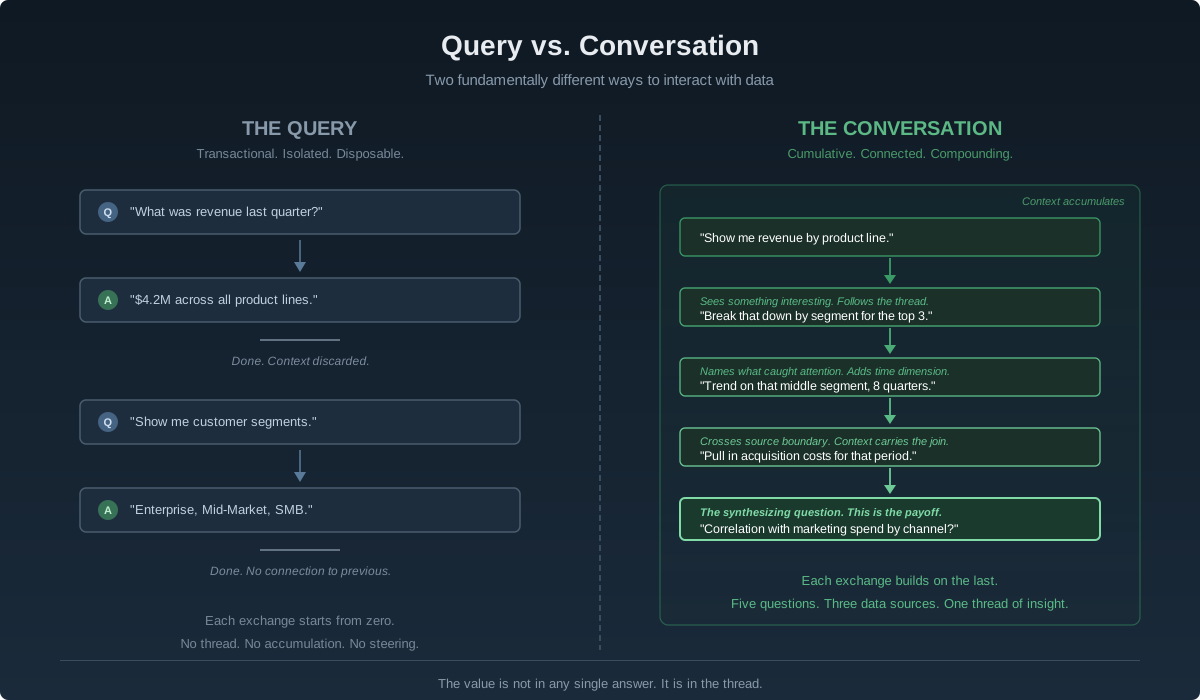
A query is transactional. You ask, you receive, you move on. A conversation is cumulative. Each exchange builds context. The AI carries forward not just the data it retrieved but the analytical frame you have been constructing together. When you ask a follow-up question, you are not starting over. You are steering.
This distinction matters because the value of conversational data analysis is not in any single answer. It is in the thread. The ability to follow a line of thinking across five or six exchanges, pulling from different sources, shifting perspective, narrowing and widening the lens, that is what replaces the two-week turnaround on a new dashboard. But it only works if the person driving the conversation understands how to maintain and direct that thread.
What Good Looks Like
The most productive data conversations I have had share a few characteristics.
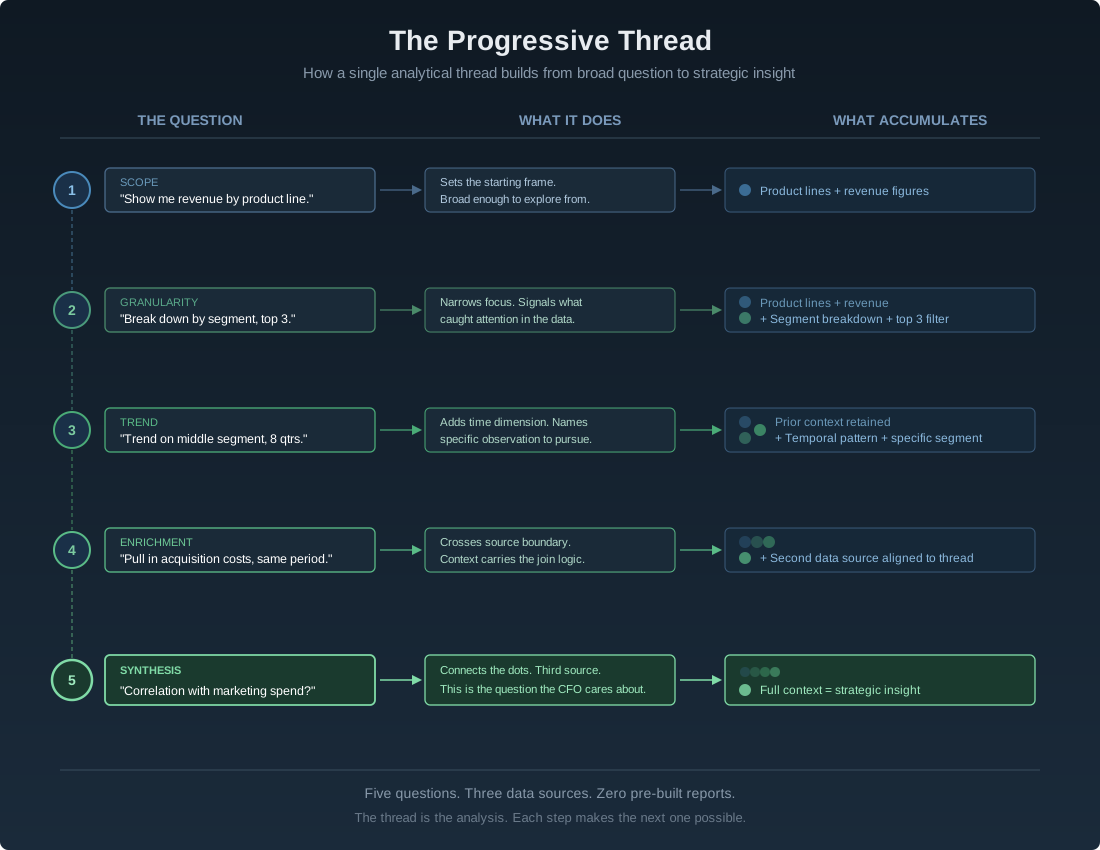
They start broad and sharpen progressively. “Show me revenue by product line” is a good opening because it gives the AI a clear starting point without over-constraining what comes next. The follow-up, “break that down by customer segment for the top three,” works because it builds on what was just returned rather than jumping to an unrelated question. Each step narrows the focus while preserving the analytical context that makes the narrowing meaningful.
They name what caught their attention. The difference between a productive and an unproductive conversation often comes down to whether the person explains why they are asking the next question. “That middle segment looks like it’s declining, show me the trend over eight quarters” gives the AI something that “show me trends” does not: a signal about what matters and why. The AI uses that signal to prioritize and contextualize what it returns.
They cross source boundaries deliberately. Some of the most valuable moments happen when the conversation pulls in a second or third data source. “Now bring in the customer acquisition costs for that same period” works because the analytical thread provides context for the join. The AI knows which time period, which segment, which product lines. That context is what makes cross-source analysis in conversation possible without someone having pre-built the integration.
They know when to ask the synthesizing question. After several rounds of drilling and exploring, the question that generates the most value is often the one that asks the AI to connect the dots. “Is there a correlation between marketing spend by channel and that segment’s trajectory?” That is the question a CFO actually cares about. Everything before it was setup.
Where Conversations Fail
The failures have been equally instructive, and I want to be honest about them because the technology’s limitations are as important as its capabilities.
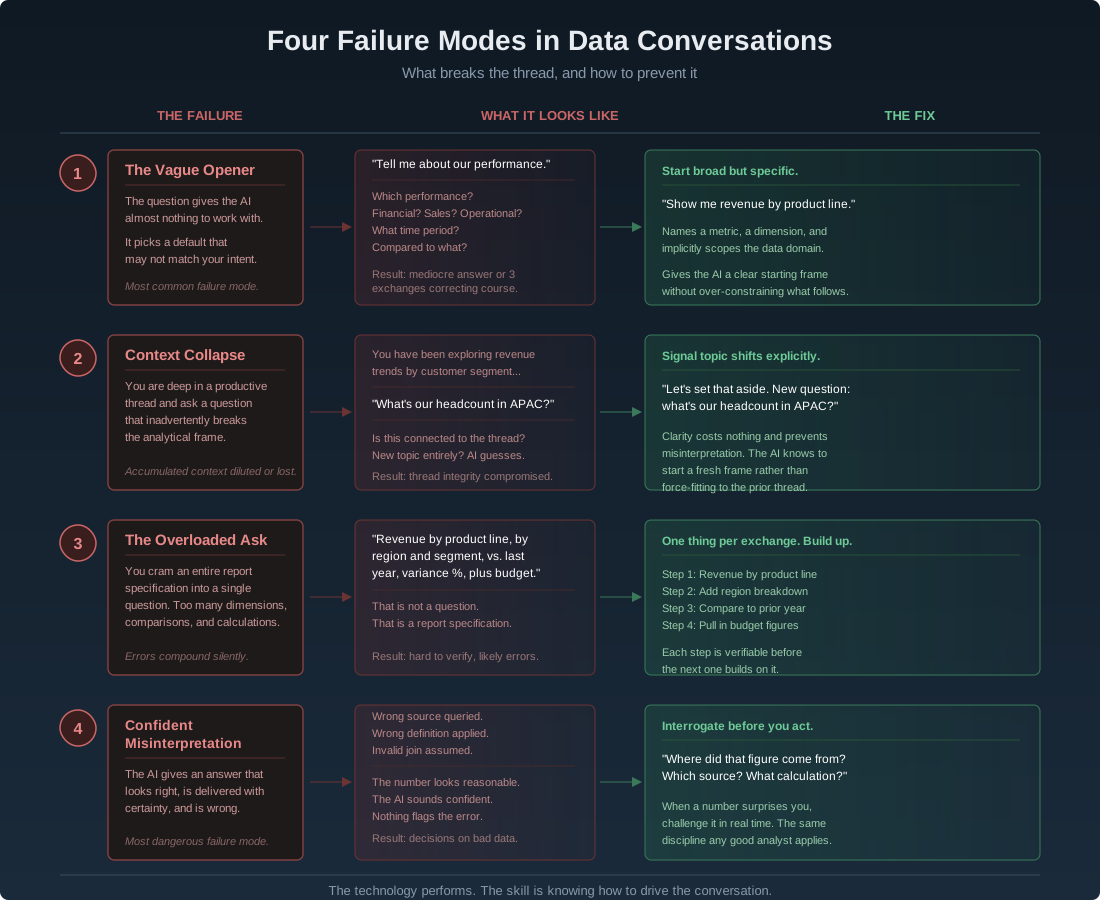
The most common failure mode is the vague opener. “Tell me about our performance” gives the AI almost nothing to work with. Which performance? Financial, operational, sales? Over what period? Compared to what? The AI will produce something, and it will look reasonable, but it will almost certainly not be what you needed. It will pick a default interpretation, and that default may not match your intent. You will either accept a mediocre answer or spend three exchanges correcting course, which is time you could have saved with a more specific opening.
Context collapse is the second major failure. This happens when you are several exchanges deep into a productive thread and then ask a question that inadvertently breaks the frame. If you have been exploring revenue trends by customer segment and suddenly ask “what’s our headcount in APAC,” the AI has to decide whether that question is connected to the thread or represents a new topic entirely. Sometimes it guesses right. Sometimes it doesn’t, and the accumulated context of the previous exchanges gets diluted or lost. The fix is simple in principle: when you shift topics, say so explicitly. “Let’s set that aside for now. New question: what’s our headcount in APAC?” That clarity costs nothing and prevents misinterpretation.
Overloading a single question is another pattern that breaks down. “Show me revenue by product line, broken down by region and customer segment, compared to the same quarter last year, with the variance as a percentage and also pull in the budget figures.” That is not a question. That is a report specification. The conversational model works best when each exchange does one thing well. You can get to that level of detail through a series of steps, each one verifiable, each one building on the last. Trying to get there in a single prompt produces results that are harder to verify and more likely to contain errors that compound silently.
The most insidious failure is confident misinterpretation. This is what happens when the AI produces an answer that looks right, is delivered with certainty, and is wrong. It queried the wrong source. It applied the wrong definition. It made an assumption about a join that seemed logical but didn’t match the business reality. This is exactly the problem semantic contracts address, but even with good semantic grounding, it happens. The defense is the same discipline any good analyst applies: when a number surprises you, interrogate it before you act on it. “Where did that figure come from? Which source? What calculation?” The conversational model makes this easy because you can ask those verification questions in real time rather than submitting a ticket.
The Skill Nobody Is Training For
Here is what concerns me about how most organizations are approaching this.
The technology to have productive data conversations exists today. The infrastructure to support it, MCP connections, semantic contracts, governed data access, is maturing rapidly. But the human skill required to use it well is almost entirely untrained.
Most business users have been conditioned by decades of dashboard consumption. They learned to interpret what someone else built. They learned to click pre-defined drill paths. They learned to request reports and wait. None of that prepares them for an environment where they hold the initiative, where the quality of the answer depends directly on the quality of the question, and where the analytical thread they construct in real time determines whether they get insight or noise.
This is not a technology adoption problem. It is a capability development problem. And it maps, imperfectly but usefully, to a skill that already exists in a different context: the ability to conduct a good interview.
A skilled interviewer does not ask random questions. They have a direction but stay responsive. They listen to what comes back and let it shape the next question. They know when to probe deeper and when to shift. They recognize when they have gotten a rehearsed answer and push past it. They synthesize as they go.
Conversational data analysis requires the same instincts applied to a different medium. The “interviewee” is the data itself, mediated by AI. The quality of the insight depends on the quality of the inquiry. And like interviewing, it is a skill that can be developed but is rarely taught.
What This Means for Organizations
If conversational data analysis is going to deliver on its promise, organizations need to invest in the human side of the equation, not just the technical infrastructure.
That starts with recognizing that this is a new competency, distinct from both traditional BI consumption and from data engineering. The people who will be most effective in this model are not necessarily the ones who are most technically skilled. They are the ones who understand the business deeply enough to ask the right questions, who can think iteratively rather than in report specifications, and who have the analytical instinct to know when an answer needs interrogation.
It also means creating space for practice. Data conversations get better with repetition. The person who has had fifty substantive conversations with their data develops instincts that the person on their first attempt simply does not have. They learn the patterns that produce insight. They recognize the failure modes before they compound. They develop a feel for when to trust and when to verify.
And it means being honest about what this model does not replace. Operational reporting still needs operational infrastructure. Regulatory submissions still need auditable, repeatable pipelines. The conversational model excels at strategic and exploratory work, at the questions nobody anticipated, at the threads of inquiry that emerge from curiosity rather than routine. Knowing which questions belong in which model is itself a skill that organizations will need to develop.
The Emerging Pattern
What I keep coming back to, after months of working this way, is that the technology is not the bottleneck. The bottleneck is how we think about the relationship between humans and data.
For decades, that relationship has been mediated by tools, reports, dashboards, and applications that stand between the person and the information they need. Those mediators imposed structure, which was necessary when the technology could not handle ambiguity. But they also imposed distance. The business user was always one or two steps removed from the data itself.
The conversational model collapses that distance. And when it does, it reveals something that was always true but rarely visible: the quality of analytical insight is a function of the quality of human inquiry. The tools were masking that relationship. Now that the tools are stepping aside, the inquiry itself is what matters.
That is both the opportunity and the challenge. And it is why the next phase of this shift is not primarily about better technology. It is about developing the organizational muscle to think with data rather than just consume it.
This is part of an ongoing series exploring how AI and conversational interfaces are reshaping data architecture and business intelligence.


